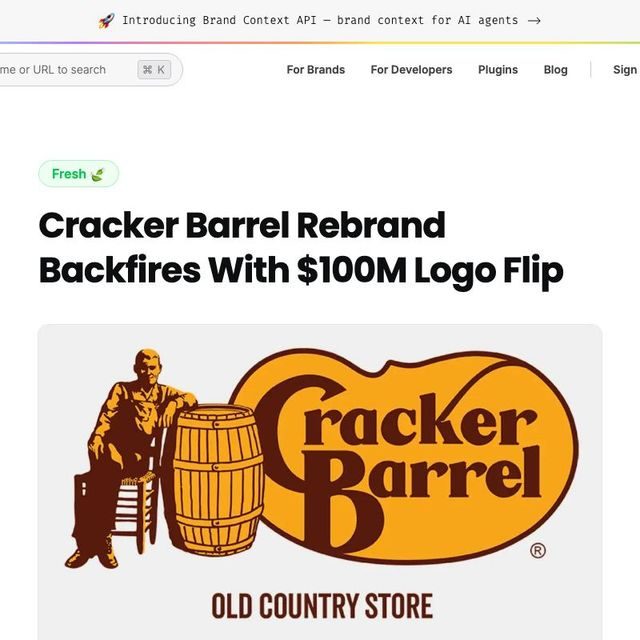
In August 2025, Cracker Barrel showed the world what happens when you fix the outside first.
A brand is a membrane. It is the boundary between what's inside an organization and what people outside perceive. Permeable, always. The inside leaks out: the culture, the way the room feels when you walk in. You do not paint a brand on. You get the inside right and let it seep through the wall. Hold that lens against Cracker Barrel and the whole episode reads cleanly.
Look at what they actually did. The refresh had three parts: store interior renovations, updated menus, and a redrawn logo. It was an identity transplant. The logo got the headlines, but the logo was the least of it. They were renovating the membrane itself.
Why? Timothy Calkins, who teaches marketing at Kellogg, names the motive plainly: "profits are down dramatically" and "the consumer base was aging." So the inside had a structural problem. Falling numbers, customers getting older. And the company reached for the surface. Modernize the look and contemporize the menu, then hope perception drags the business along behind it. Branding from the outside in. It reverts within a year. This one reverted within weeks.
Here is the part that should sting any designer. The interior changed from "the eclectic, well-worn Southern look" to "a modern farmhouse aesthetic." The lattice that divided the tables became an open bookcase. The paint went a lighter gray. Read those as cosmetic and you miss the whole thing. The clutter was the brand. The well-worn warmth and the density of the room: that was the felt experience of dealing with Cracker Barrel. That was the asset. They sanded it off trying to fix perception, when perception was the one thing already working.
The membrane leaked, the way it always does. A customer: "They done took all the character out of it." Another: "This is a gentrified Cracker Barrel." Those are people detecting an inside change through the wall. The redesign told them something true about where the company's head was, and they read it instantly.
And the rollout exposed how thin the conviction was. The chain ran the new design in four of its 660 stores, then steered the whole brand toward it. Four. When the reversal came on September 9, 2025, the company re-committed to the exact physical cues it had been removing: "the rocking chairs on the porch, our fireplaces and peg games, unique treasures in our gift shop and antiques pulled straight from our warehouse in Lebanon, Tennessee." They had to write down the felt experience to remember it was the product. The market liked the retreat. Shares rose more than 7 percent after the logo reversal.
Jaguar made the same mistake from the other end. In November 2024 it launched a new identity with a campaign film of colorfully dressed models and slogans like "Delete Ordinary." No cars. It had paused new car sales while it switched to electric, so there was nothing real behind the membrane when the membrane went public. The diagnosis sticks: it landed as "we no longer care about you." An outside with no inside ready to leak.
Contrast the shape of the brand work Irvan led for the Indonesian Ministry of Education. Akun Belajar.id became the single sign-on for tens of millions of students and teachers. Merdeka Mengajar reached teachers across more than 17,000 islands. None of that brand lives in a logo. It lives in whether a teacher on a remote island can actually log in, whether the language in the app sounds like a person who respects them, whether the thing works on the connection they have. The inside was the work. The brand was what leaked out once the inside held. That is the only direction that survives a year.
So anyone about to commission a rebrand should answer one question first. What are you actually changing? If the felt experience is broken, the new identity is honest and the old customers will leave anyway. If the felt experience is the asset, you are about to sand it off and call it strategy. Cracker Barrel could not tell the difference until it cost them. Can you?




.webp)
.webp)
.webp)

