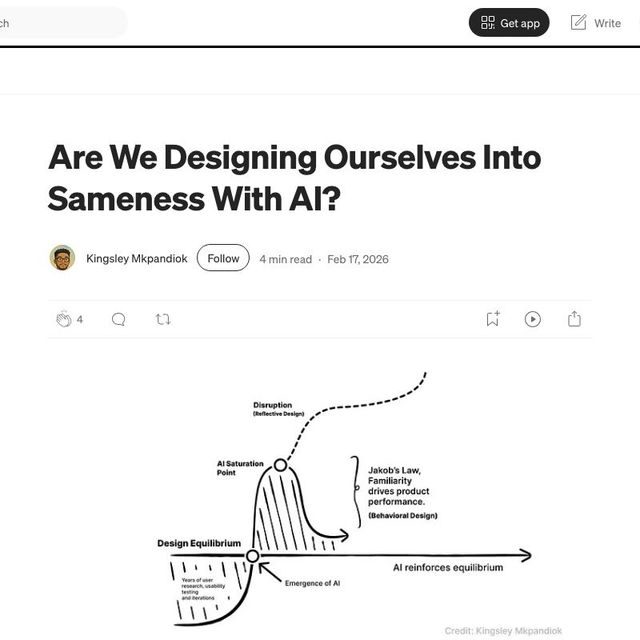
The discourse has a tidy villain now. A February 2026 essay puts it plainly: AI design tools "begin with probability," they "scan thousands of existing interfaces, identify the most recurring patterns, and reproduce what statistically performs." The implication is that the web looked varied until the models showed up and flattened it. Comforting. It lets every designer who shipped the eighth identical dashboard off the hook.
The timeline does not cooperate. A CHI 2021 study measuring web design homogenization found that layout similarity distance "declined 44% from 2010-2019." Diffusion models were not in production in 2019. The flattening was already most of the way done. The same study found sites "became less homogenous from 2003-2007, and then dramatically more homogenous after." The web was diverging. Something reversed it. That reversal landed years before a single interface was generated by a model.
The study names the mechanism, and it is not AI. The researchers point to "the introduction of content management templates and pre-packaged libraries and frameworks in and around 2013," with a small set of libraries (including jQuery's UI package) growing around 2017. They found that "the use of similar libraries strongly correlates with visual similarity." Shared frameworks. Design systems. Defaults that nobody chose so much as inherited.
You can see the result without a study. Open five B2B SaaS products. White or light gray backgrounds. Blue primary buttons in the same shade of blue. Inter, Roboto, or SF Pro. They are, as one writer puts it, "technically well-designed but completely forgettable. Users can't tell them apart." This was the deal design systems offered, and the deal was honest. Consistency makes products learnable. It speeds teams up. It cuts decision fatigue. We took it. The forgettableness was the price, and we paid it a decade ago.
So I will concede the part that holds. AI does compress diversity. A peer-reviewed Science Advances study found generative tools make outputs "more similar to each other," buying individual creativity "at the risk of losing collective novelty." That is real and measurable. But it is a newer, thinner effect stacked on top of an old, thick one. Even the writers blaming AI half-admit this. The February essay concedes the equilibrium already existed: AI "doesn't disrupt that equilibrium. It reinforces it, faster than any human team ever could." Reinforces. Not authors. AI walked into a room that was already beige and turned up the lights.
Here is the lens. A brand is a membrane. It is the boundary between what is inside an organization and what people outside perceive. Permeable, always. The inside leaks out: the felt experience of dealing with you. You do not paint distinctiveness onto the surface. You get the inside right and let it seep through the wall.
An interchangeable product has a thin membrane. There is nothing distinctive inside to leak. So the sameness is the honest readout of an inside that looks like everyone else's: the same empty states, the same opinions about what a user is. A better gradient does not touch it. Shared libraries did not just standardize buttons. They standardized the thinking behind the buttons. The default became the position.
This reframes the fix, and it kills the popular one. More surface originality is a fresh coat of paint on a thin wall. It reverts the moment the next redesign cycle reaches for the defaults again. The arXiv work on AI and diversity locates the actual lever: variance collapses through "epistemic deference," and recovers "only when humans actively curate rather than passively defer." Deference is the disease. It is the same deference designers handed Bootstrap in 2017, now handed to a model. The cure is a strong inside making real choices. A real opinion about who sits at the center of your product, expressed in defaults you picked on purpose instead of ones you inherited.
So before anyone commissions originality as a deliverable, answer one question. If you stripped your product down to its copy, its empty states, and the way it handles a user's worst day, would anything left be unmistakably yours? If not, no font fixes that. And AI is not what made it true.






.webp)
.webp)
.webp)

